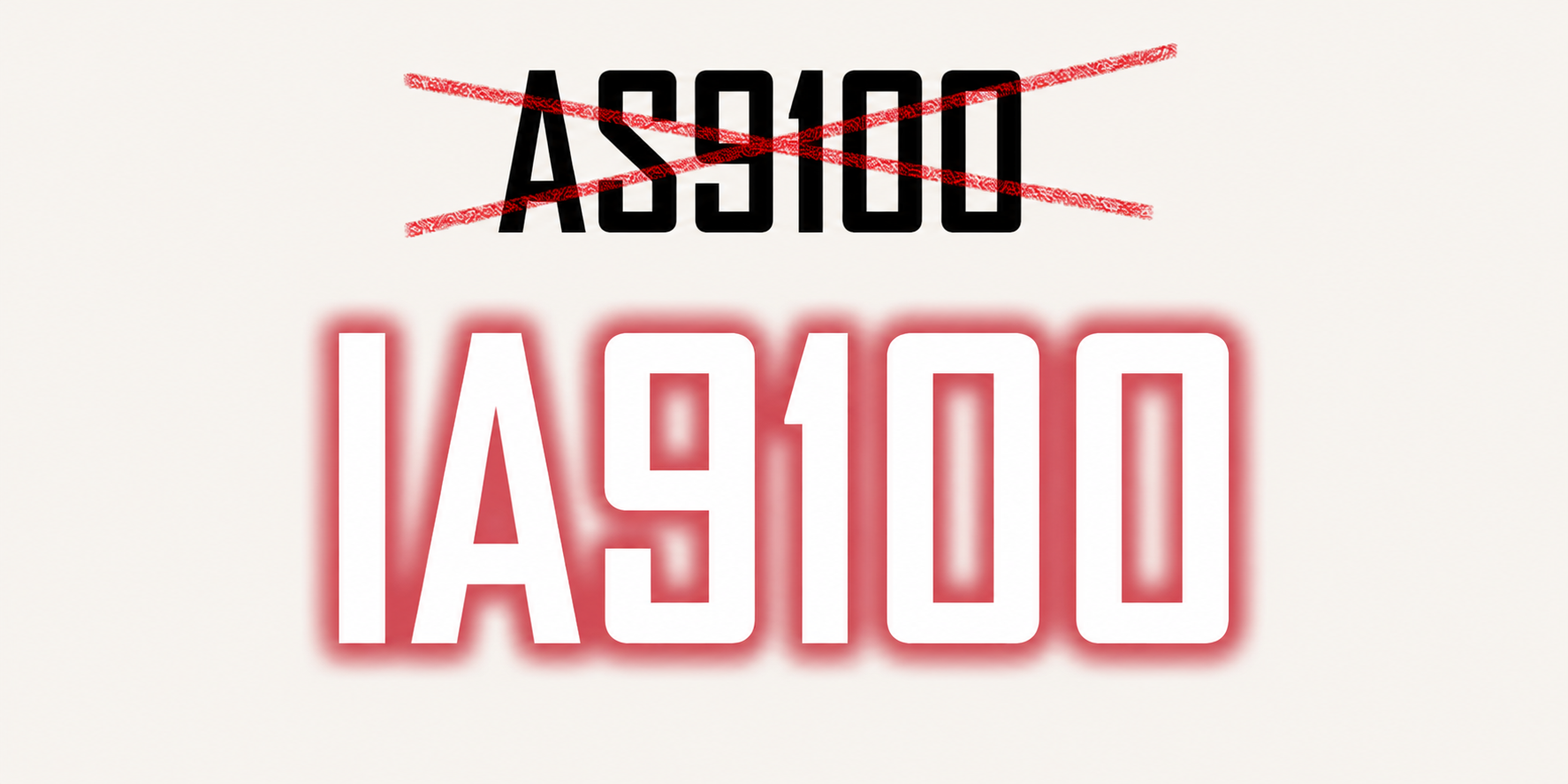
A recent press release from QA veteran Daryl Guberman makes a sharp point. The proposed transition from AS9100 to IA9100 is being framed as reform. It isn't. It's a relabel. And relabeling a standard does nothing to address two decades of weakened oversight, diluted audits, and accreditation-by-association that has accumulated in the aerospace supply chain since 9/11.
We agree with the diagnosis. We'd take it one step further.
The problem isn't the name of the standard. The problem is that aerospace quality assurance is still anchored to documents, audits, and trust marks. Paper compliance. Periodic snapshots. Attestations that travel separately from the parts and materials they're supposed to vouch for.
That model has been failing in public.
AOG Technics put forged paperwork on engine parts that ended up on commercial aircraft. EASA has flagged the recirculation of stolen and undocumented parts back into the legitimate supply base. The F-35 program disclosed a Chinese-sourced alloy in a magnet assembly that slipped through years of supplier attestations. Each of these is a paperwork failure, not a metallurgy failure. The parts looked fine. The documents looked fine. The chain of custody between them was the weak link.
You cannot accredit your way out of that. Guberman is right.
What "identity at the part" actually changes
The fix isn't a better audit cadence. It's making the part itself the source of truth.
At DUST, we bind an unclonable physical identity directly to the material or component, then anchor every downstream event, who handled it, who inspected it, what process it went through, what test data it generated, to that identity. The certificate of conformance doesn't live in a PDF anymore. It lives on the part. The digital thread isn't a database someone has to trust. It's a record cryptographically tied to a physical mark that can't be transferred, swapped, or forged.
That changes what an audit is.
Today, an AS9100 or IA9100 audit asks: do you have a process? Do you have records? Can you produce them on request? Tomorrow's audit, the one the flying public actually needs, asks: can you prove, at the part level, that what you shipped is what your records say you shipped? That's a question paper can't answer. Physical identity can.
Why the rename misses the point
Guberman's frustration with IA9100 is that it preserves the same accreditation pathways, the same incentives, and the same enforcement gaps under a new logo. He's describing a governance problem.
There's a technical problem sitting underneath it. Even with perfect governance, paper-based traceability gives auditors and primes a representation of reality, not reality itself. The gap between the representation and the actual part is where AOG Technics operated. It's where stolen parts re-enter the system. It's where adversarial sourcing gets laundered through a clean-looking supplier chain.
Standards bodies can tighten language. Accreditation bodies can tighten audits. Neither closes that gap. Only ground truth at the part closes that gap.
What primes and operators should be asking suppliers in 2026
Three questions worth putting on the table, regardless of which version of the standard is in force:
Can you prove the physical identity of this part is the same identity referenced in your CofC? Not the serial number. The part itself.
If this part shows up at an MRO facility in three years, can the technician verify its origin without calling your records department?
If a counterfeit or out-of-spec equivalent enters the supply chain wearing your part number, what stops it from being installed?
If the answers are "we have a process for that" rather than "yes, and here's the cryptographic proof," the gap Guberman is warning about is still open.
The bottom line
Guberman closes with a line worth repeating. "Standards don't fail. People, processes, and compromised oversight fail."
True. And the way you protect people and processes from the next failure isn't a new acronym. It's an authentication layer the supply chain can't game, because it doesn't live in the paperwork. It lives on the part.
That's the work.