
Material Compatibility & Validation

How we validate dust across materials
From aerospace alloys to luxury leather, DUST creates a unique, physical identity on substrates used in real-world supply chains—enabling unclonable provenance, traceability, and authentication at scale.
DUST binds a unique, physical identifier to real-world items across the materials that matter most in high-value supply chains. Our technology is designed to work across diverse substrates enabling unclonable provenance, authenticity, and traceability from raw material production through end of life.

Metal & Alloys
Designed for high-value, high-riskindustrial and aerospace supply chains.
Examples: Carbon fiber composites (CFRP), glass fiber composites, prepreg materials, resin systems, structural laminates.

Composites
Item level secure identity for materials that lack inherent serialization and are hard to trace by batch alone.
Examples: Carbon fiber composites (CFRP), glass fiber composites, prepreg materials, resin systems, structural laminates.

Leather and naturale luxure materials
Non-invasive marking options for premium goods and resale authentication.
Examples: Full-grain leather, calfskin, suede, nubuck, coated leather, trims and leather components.

Textile & soft goods
Designed for durability and verification across fashion, accessories, and premium manufacturing.
Examples: Wool, cashmere, cotton, silk, blended fabrics, technical textiles, woven labels, interior linings.
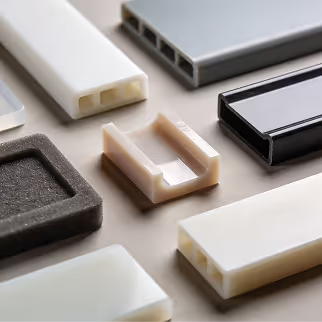
Polumers &
Plastics
Support for engineered parts, molded components, and packaging elements.
Examples: Injection molded plastics, engineering polymers (e.g., PEEK-class), nylon, polycarbonate, ABS.

Precious materials & Collectibles
Trusted identity for high-value items in secondary markets
Examples: Gold, silver, platinum, gemstones, watches, memorabilia, coins, limited editions.

Labels, packaging & Certification materials
Connect physical items to the
documents and packaging that seal and certify them.
documents and packaging that seal and certify them.
Examples: Certificates of authenticity, compliance documents, warranty cards, tamper-evident security labels, serialized packaging.
How we validate dust across materials
Every material behaves differently. Surface energy, porosity, coatings, temperature exposure, abrasion, chemical treatments - all impact long-term durability.
DUST is validated through structured material-specific testing before any deployment.
DUST is validated through structured material-specific testing before any deployment.
01
Material-Specific application protocols
Creating a Unique Fingerprint
For each substrate, we define:
Surface preparation requirements
Throughput Requirements
Application method
Optimal placement zones
Density and pattern specifications
Environmental constraints
Serialization space requirements
Each material receives a documented application protocol prior to pilot.
02
Durability & Stress testing
DUST is tested under real-world conditions relevant to each industry.
Depending on the material, testing may include:
Abrasion resistance
Heat and thermal cycling
Chemical exposure
UV exposure
Moisture and humidity
Friction and handling stress
Mechanical wear
Cleaning agents (luxury & aftermarket scenarios)
High Pressure (underwater scenarios)
Salinity (maritime scenarios)
For aerospace materials, testing aligns with expected MRO and operational environments.
For luxury goods, testing includes after-sales handling and resale
workflows.
For luxury goods, testing includes after-sales handling and resale
workflows.
03
Optical & Signal verification testing
We validate:
Readability consistency
Tag stability over time
Performance under different lighting conditions
Optical cross compatibility across device types
False positive / false negative thresholds
This ensures the physical identity remainsmachine-verifiable — not subjective.
04
Non-Damaging & Aestetic review
When Applicable
For luxury, collectibles, and consumer-facing goods, we validate:
No surface degradation
No discoloration
No tactile impact
No visible disruption unless intentionally designed
Non-invasive marking is defined and agreed upon before deployment.
05
Pilot validation & Documented results
Before scale deployment, we run:
Controlled pilots
Sample batch validation
Lifecycle monitoring
Data performance analysis
Each program produces documented validation results suitable for enterprise review.
06
Enterprise-Grade deployment
DUST is not just applied - it is engineered per material, validated under
stress, and monitored over time.
stress, and monitored over time.
Because traceability only works if the physical identity endures.
Build on identity that cannot be copied
Talk to us

©2026 All Rights Reserved by Dust Identity. Trust in Things™