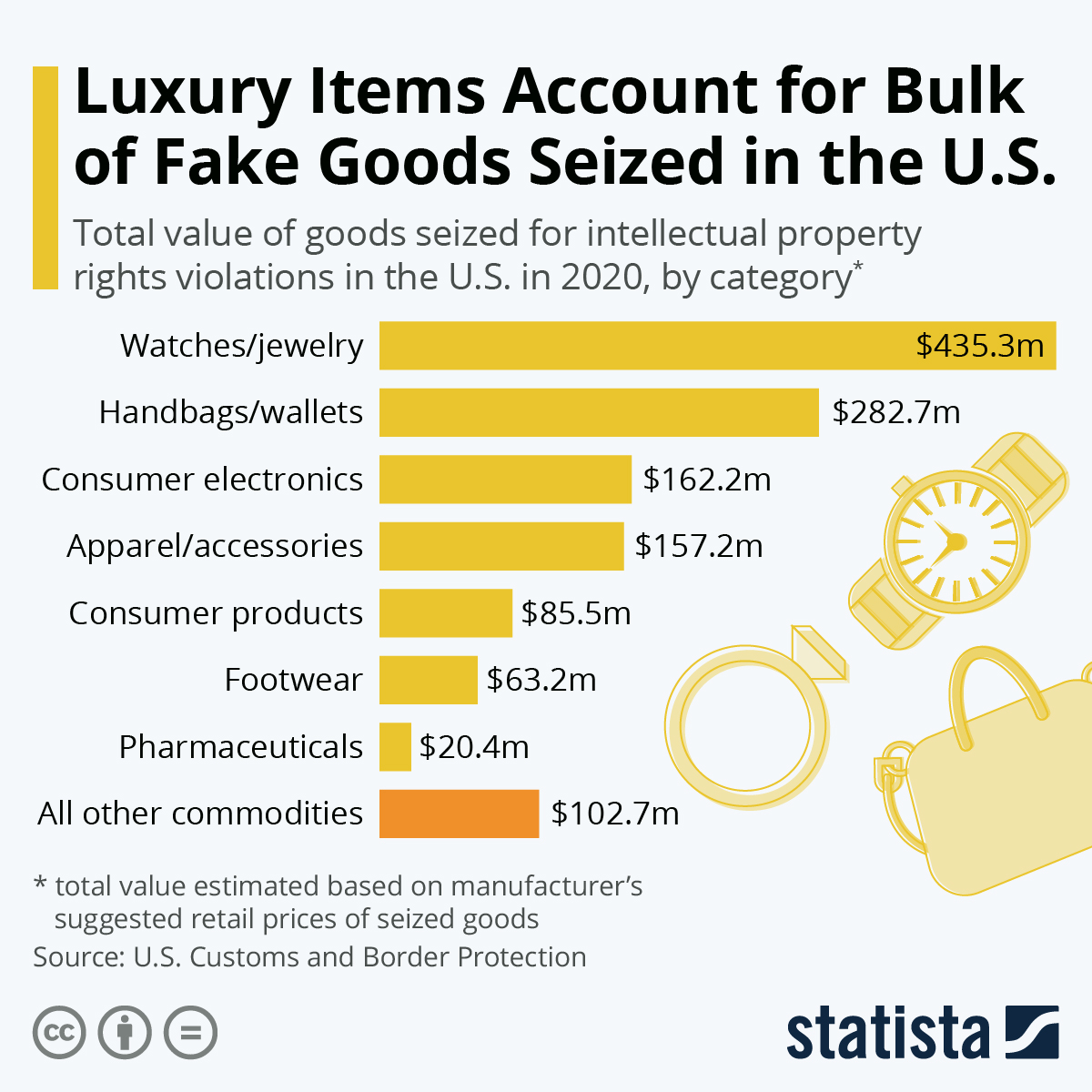
According to the OECD and the European Union Intellectual Property Office, global trade in counterfeit and pirated goods reached $467 billion in 2021. That figure represents 2.3 percent of all international commerce — roughly one dollar in every forty-four spent on traded goods, going to fakes.
By 2030, one credible projection puts that number at $1.79 trillion.
These figures capture only what moves across borders and gets caught or estimated. They do not count counterfeit goods produced and consumed domestically. They do not count pirated digital products. They do not count the downstream costs: the recalled products, the hospitalizations, the failed weapons systems, the brand equity destroyed when a customer buys what they believe is your product and it poisons them. When researchers at Frontier Economics attempted to measure the full economic displacement — revenue lost, jobs eliminated, taxes uncollected — they arrived at a figure of $1.1 trillion for 2022 alone, resulting in the loss of up to 5.4 million jobs worldwide.
Some analysts, working with wider definitions and longer time horizons, place the total annual cost of global counterfeiting and piracy at between $1.7 trillion and $4.5 trillion.
This is not a market anomaly. It is a structural feature of the global economy — one that has grown faster than legitimate trade for over a decade, and one that existing tools have demonstrably failed to contain.
The Limits of What We've Tried
The instinct, for most of the past two decades, has been to treat counterfeiting as an information problem. If we could just track objects better — apply a barcode, add a serial number, issue a certificate — we could restore trust to supply chains.
That instinct produced real infrastructure. Pharmaceutical serialization laws now cover the majority of medicines sold in developed markets. The U.S. Drug Supply Chain Security Act mandates end-to-end traceability for prescription drugs. The EU's Falsified Medicines Directive requires unique identifiers on packaging. Luxury brands invested billions in holographic seals, QR codes, and covert inks.
And yet, as we explored in our first post in this series, every one of these technologies authenticates the label rather than the object. A barcode is a number printed on paper. A hologram is a pattern applied to a surface. A QR code is data encoded in an image. Each can be reproduced with equipment that has become cheaper every year.
The counterfeiters adapted. They always do.
The question is not whether our existing tools are well-intentioned or even well-executed. The question is whether they are sufficient for a problem that has continued to grow despite their widespread adoption. The evidence strongly suggests they are not.
Three Industries Where the Cost Is No Longer Abstract
Numbers in the trillions are difficult to make visceral. The following three examples are attempts to do that — to connect the abstract economic damage to specific, documented consequences.
Defense and Aerospace: When Fake Parts Kill Missions
In the summer of 2022, eighteen newly completed F-35 fighter jets sat grounded outside Lockheed Martin's Fort Worth facility. Pentagon officials had halted deliveries after discovering that a key magnet in an engine component had been manufactured for years using raw materials sourced in China — a violation of federal procurement rules. The aircraft were ready. The supply chain was not.
That incident was disruptive. Others have been deadly.
In June 2020, Air Force pilot First Lieutenant David Schmitz died when his parachute failed to deploy from a malfunctioning ejection seat. An Air Force Research Laboratory investigation found that the seat may have contained up to ten counterfeit and faulty transistors and semiconductor chips. His widow filed a federal civil lawsuit against three defense contractors. The case surfaced a question the Pentagon has struggled with for more than a decade: when a complex weapons system draws on over a million suppliers across multiple tiers of subcontractors, how do you verify that every part is what it claims to be?
The Department of Defense estimates that as much as 15 percent of spare and replacement parts for military electronics turn out to be counterfeit. A 2012 Senate Armed Services Committee investigation — considered the most comprehensive public examination of the problem to date — uncovered more than 1,800 cases of counterfeit electronic parts in use across military aircraft, missiles, surveillance systems, and collision-avoidance systems. The total count of suspect individual components exceeded one million.
The economic cost to U.S. semiconductor manufacturers from parts counterfeiting was estimated at $7.5 billion in 2018. The strategic cost — compromised readiness, degraded reliability, the possibility of adversarial hardware trojans — is harder to price.
Pharmaceuticals: When Fake Medicine Kills Patients
The World Health Organization estimates that one in ten medicines circulating in low- and middle-income countries is substandard or falsified. In some parts of sub-Saharan Africa, the share is believed to run as high as 50 percent.
In February 2023, the United Nations Office on Drugs and Crime released a report estimating that counterfeit medicines in sub-Saharan Africa may be responsible for nearly 500,000 deaths per year. Of those, approximately 267,000 are linked to falsified or substandard antimalarial medicines. A further estimated 169,000 are connected to counterfeit antibiotics given to children with pneumonia.
These are not numbers from the distant past or the developing world alone. In late 2023, Brazil's health authority issued warnings about counterfeit versions of Ozempic and a Biogen multiple sclerosis treatment actively circulating in the market. In 2022, WHO flagged substandard cough syrups that were linked to the deaths of 66 children in Gambia. Counterfeit versions of cancer drugs — medications with no active ingredient, administered to patients who believed they were receiving treatment — have been documented in clinical settings across Europe and North America.
The pharmaceutical supply chain has more track-and-trace infrastructure than almost any other industry. Serialization is mandatory in the world's largest markets. Unique identifiers appear on virtually every prescription package sold in the United States and European Union.
And still, half a million people may be dying every year from medicines that are not what the label says they are.
Energy and Industrials: The Hidden Inventory Problem
The cases above attract attention because they are dramatic. But the counterfeiting problem extends into industries that rarely make headlines: energy infrastructure, industrial machinery, EV battery systems, and the vast middle of manufacturing where counterfeit fasteners, capacitors, and materials infiltrate supply chains quietly, degrading performance over time rather than failing catastrophically.
The rapid scaling of electric vehicle production has introduced a new attack surface. EV battery cells are high-value, technically complex, and involve deep supply chains that stretch across multiple continents. The incentives to substitute inferior or falsified cells are significant. The consequences — degraded range, accelerated aging, or in worst cases thermal runaway — take time to manifest, which means they often cannot be traced back to their source by the time they occur.
Industrial counterfeiting rarely generates the urgency of a grounded fighter jet or a contaminated drug. But it is persistent, pervasive, and expensive. And it is growing.
Why Enforcement Alone Will Never Be Sufficient
The standard response to these numbers is to call for better enforcement: more customs inspections, heavier penalties, greater international coordination. These are reasonable positions. But they rest on an assumption that deserves scrutiny — that counterfeiting is primarily a detection and deterrence problem.
It is also, and perhaps more fundamentally, a verification problem.
Customs officials and brand protection teams cannot inspect every shipment. They cannot decapsulate every chip or run mass spectrometry on every tablet. Even the most aggressive enforcement regimes operate as probabilistic filters, catching some portion of fakes while the rest pass through. The OECD notes that around 65 percent of counterfeiting seizures now involve small parcels and postal shipments — volumes that make comprehensive inspection physically impossible.
As long as any object can be replicated and labeled, the burden falls entirely on downstream detection. That burden is too heavy. It will always be too heavy, because the economics favor the counterfeiter: production costs are low, detection rates are imperfect, and the penalty, when caught, is rarely sufficient to offset the profit.
The only durable solution is to shift the question from "did we catch the fake?" to "can the genuine article prove it is genuine?" — at any point in its lifecycle, by any party in the supply chain, without relying on a database that can be corrupted, a label that can be copied, or a seal that can be reproduced.
This requires that the object itself carry an identity that cannot be transferred, duplicated, or forged. An identity rooted not in information, but in physics.
The Scale of the Problem Is an Argument for Physical Trust
When we look at the full ledger — $467 billion in traded fakes conservatively estimated, up to $1.79 trillion projected by 2030, and total economic displacement potentially running into multiple trillions — a few things become clear.
First, the problem is large enough to justify significant investment in new approaches. The question is not whether authentication infrastructure is worth building; it is whether the infrastructure being built is adequate to the threat.
Second, the industries bearing the highest costs — defense, pharmaceuticals, energy — are precisely the industries where the consequences of failure extend beyond financial loss into human life, national security, and critical infrastructure. These are industries where the probability of harm matters as much as the magnitude.
Third, the current toolkit is not solving the problem. Counterfeiting has grown faster than legitimate trade over the past decade, during the same period in which serialization, QR codes, and holographic technologies were widely deployed. The tools are working at the margin. They are not working at the scale of the problem.
At DUST Identity, we built our technology on the premise that the solution to a physical problem requires a physical answer. Our diamond-particle tags create a unique, unclonable fingerprint at the atomic level — one that cannot be reproduced because it is governed by quantum physics rather than manufacturing precision. The fingerprint lives in the object. It travels with the object. It can be verified anywhere in the chain, at any time, without trust in any intermediary.
We did not build this technology because counterfeiting was an interesting academic problem. We built it because the cost of getting identity wrong — in defense systems, in pharmaceutical supply chains, in critical infrastructure — is measured in lives, not just losses.
The trillion-dollar number is a symptom. The root cause is simpler: most physical objects in the world still have no way to prove what they are.
That is the problem we are solving.